
A critical care nurse typically works in the intensive care unit, or ICU. The critical care unit is where patients with severe and life-threatening injuries and illnesses are treated. An intensive care nurse may specialize in areas like cardiac, pediatric, or neonatal intensive care.
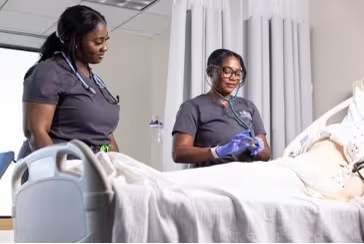
After earning your Bachelor of Science in Nursing (BSN) and entering the field, find direction in choosing a specialty by aligning your strengths and interests with specific practice areas. For example, if you feel that you would thrive in a fast-paced environment and would like to manage complex cases, then becoming a critical care nurse could be the right choice for you.
What is a critical care nurse? These professionals deliver treatment to critically ill or injured patients while serving as an advocate and coordinating with the rest of the patient care team. Mercer University’s Second Degree Accelerated Bachelor of Science in Nursing (ABSN) track allows students to earn their nursing degree in as few as 12 months, offering an education that prepares students for a wide range of practice areas.
Explore what a critical care nurse does, how it differs from acute care, and the steps to becoming a nurse.
What Is a Critical Care Nurse?
A critical care nurse works with patients who have severe and complex illnesses or injuries. These critically ill patients, who may have life-threatening conditions, are typically treated in the intensive care unit (ICU). The ICU is the most common type of critical care setting. This high-tech environment features cutting-edge equipment to continuously monitor and treat patients, allowing critical care nurses to respond quickly to changes in a patient’s condition.

What type of nurse should you be? Explore different nursing specialties to weigh your options.
Types of Critical Care Nurses
Where do critical care nurses work? While many critical care nurses work in a generalized ICU, some critical care nurses work in specialized units caring for critically ill or injured patients. Some examples of other types of critical care nurses and their responsibilities include:
- Cardiac/cardiothoracic ICU nurse: Cares for patients with heart-related conditions
- Neurological ICU nurse: Works with patients with brain and spinal problems
- Pediatric ICU (PICU) nurse: Treats critically ill children
- Neonatal ICU (NICU) nurse: Treats critically ill and premature infants
- Transplant ICU nurse: Works with transplant patients
- Burn unit nurse: Cares for patients with severe burns
- Flight nurse: Stabilizes patients on board emergency medical flights
Other critical care nurses work in various emergency department or trauma center settings.
What Do ICU Nurses Do?
What is a critical care nurse’s most important responsibility? These nurses handle important tasks, including:
- Patient monitoring and assessment: Critical care nurses must provide ongoing assessment of their patients and be prepared to intervene.
- Equipment set-up: A critical care nurse must set up, operate, and utilize sophisticated medical equipment while providing patient-centered care.
- Treatment administration: In the critical care unit, patients may need pain medications, sedatives, and other medications. They may also need ventilators and advanced life support.
- Tests: ICU nurses may care for patients undergoing diagnostic tests and communicate findings from diagnostic tests to inform their patients’ care.
- Advocacy: Critical care nurses serve as patient advocates, ensuring patients can make informed decisions and that those decisions are respected.
- Emergency response: It is not unusual for a patient in the ICU to experience a medical emergency, such as a cardiac arrest or respiratory failure. ICU nurses must respond quickly and initiate life-saving interventions.
What Is the Difference Between Critical Care and Acute Care?
Before you decide whether to become an intensive care nurse, it is important to understand the differences between types of care. Acute care involves sudden, short-term illnesses and injuries. It encompasses everything from a broken bone to an asthma attack or an allergic reaction. This differs from chronic care, which involves conditions that persist on a long-term basis, such as fibromyalgia or arthritis.
Critical care does involve acute conditions, but it is not the same as acute care. The difference lies primarily in severity. Critical care nursing involves treating severe, life-threatening conditions that require complex care, continuous monitoring, and advanced interventions. These conditions include heart attack, stroke, sepsis, and catastrophic injuries like traumatic amputations.

How to Become a Critical Care Nurse
If you aspire to work with high-risk patients, consider how to become an ICU nurse. While the career pathway can vary from one nurse to another, the general steps are as follows:
1. Earn a BSN
It is possible to become a critical care nurse with an Associate Degree in Nursing (ADN). A BSN, however, provides more thorough preparation for a high-demand nursing specialty like critical care. In addition, employers prefer to hire baccalaureate-prepared nurses.
At Mercer University, our ABSN curriculum covers everything you would learn in a traditional four-year BSN education, from health assessment to pharmacology and beyond. You will take nursing theory courses online and visit our ABSN Learning Site in Atlanta for in-person nursing skills and simulation labs. You will also complete clinical rotations, gaining hands-on experience in practice areas including adult health, acute care, intensive care, and pediatrics.
2. Pass the NCLEX-RN and Obtain Licensure
Mercer University thoroughly prepares our nursing students to excel on the NCLEX-RN. This is the national licensure exam that all aspiring RNs must pass. You will also have time to study for the exam after graduating, depending on when you schedule your test. Upon passing, you can qualify for your state-issued nursing license.
3. Gain Critical Care Nursing Experience
With your RN license in hand, you can start applying to entry-level ICU nursing jobs. Depending on the job market in your area, you may need to expand your search a bit. If you do not find an ICU opening right away, consider looking for work in a related setting, such as the emergency room or cardiac catheterization lab.
4. Consider a Professional Certification
What certifications are needed to be a critical care nurse? An entry-level critical care nurse is expected to have certifications such as:
- Cardiopulmonary resuscitation (CPR)
- Basic life support (BLS)
- Advanced cardiovascular life support (ACLS)
While you can pursue a role in the ICU as an RN without specialty certification beyond CPR, BLS, and ACLS, earning a critical care certification will demonstrate advanced expertise and may lead to new opportunities for your career. You can pursue a certification from the American Association of Critical-Care Nurses (AACN) after gaining clinical experience. This certification confers the designation CCRN. You can choose a certification in subspecialty areas, such as:
- Adult
- Cardiac medicine (CMC)
- Cardiac surgery (CSC)
- Neonatal
- Pediatric

What is nursing school like? Learn what to expect and how you can thrive.
How Much Does a Critical Care Nurse Make?
A critical care nurse’s salary can vary based on factors including geographic location, employer, years of experience, certifications, and academic qualifications. How much does a critical care nurse make in general? The U.S. Bureau of Labor Statistics (BLS) does not track salary data for critical care nurses specifically, but a general sense of salary expectations may be extrapolated from the median pay for all types of RNs. The BLS reports that registered nurses made a median annual salary of $93,600 as of May 2024.
Essential Skills and Qualities for Critical Care Nursing
When considering how to become an ICU nurse, it is helpful to examine the different skills and qualities that are important for this specialty. One of the most important skills is advanced cardiac life support, as ICU patients sometimes need rapid interventions in the event of respiratory failure or other complications. Other important skills and qualities include:
- Adaptability
- Attention to detail
- Communication skills
- Critical thinking and problem-solving
- Emotional resilience
- Patient assessment
- Patient education
- Proficiency with technology
- Teamwork

Prepare for a Critical Care Nursing Career at Mercer University
Mercer University maintains a longstanding history of academic excellence. Our ABSN track fosters social responsibility, evidence-based professional practice, and innovation in nursing. You will work through an accelerated curriculum that will prepare you to pursue any type of nursing specialty, including critical care nursing. You can benefit from small class sizes, personalized support from faculty and staff, and graduate in as few as 12 months after completing any needed prerequisites.
Request information to learn more about applying to our ABSN track in Atlanta, Georgia.